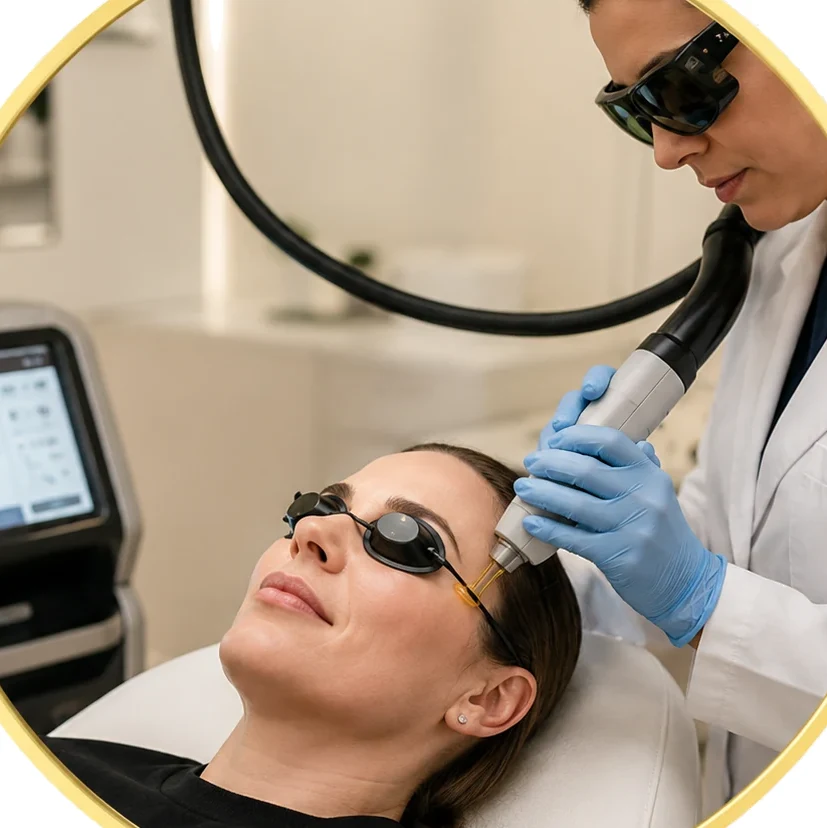

Filler migration means injected product has moved away from where it was placed and is now detectable beyond the intended treatment area. Most cases are manageable once assessed properly, but the right next step depends on the material used. Avoid pressing or massaging the area yourself, and book a clinician review — hyaluronic acid (HA) migration usually responds to hyaluronidase, while permanent fillers often need surgical removal.
TL;DR:
- Filler migration often results from superficial injection, high pressure delivery, or poor technique, especially in highly mobile areas like lips or the glabella.
- Permanent fillers cannot be dissolved and usually require surgery for removal if they migrate, whereas hyaluronic acid fillers respond well to hyaluronidase treatment.
- Most migration cases are manageable with proper assessment, and urgent intervention is only necessary if signs of vascular compromise or skin discoloration occur.
- Prevention hinges on choosing an experienced, qualified injector, using conservative volumes, and matching the filler type to the area and injection plane.
- Self-diagnosis is unreliable; professional evaluation with ultrasound helps determine whether migration or another issue is present and guides effective treatment.
Table of Contents
- What is filler migration and how is it different from swelling?
- What causes filler migration?
- How to prevent filler migration
- What to do if you suspect filler migration
- How clinicians treat filler migration
- Why imaging matters before treatment
- When filler migration needs urgent medical attention
- The gap between what patients fear and what actually happens
- Book a clinician-led assessment with Nexgen Clinic
- Sources
- FAQ
What is filler migration and how is it different from swelling?
Migration is a structural problem: product sitting outside the plane it was injected into, or spreading beyond the border of the treated area. Swelling, by contrast, is your body's normal inflammatory response to the needle or cannula passing through tissue, and it typically settles within days.
The distinction matters because the two look similar at first glance but need completely different responses. Swelling is diffuse, symmetrical, and improves day by day. Migration tends to be localised, often asymmetrical, and either stays static or slowly worsens over weeks. A lump that was not there at your two-week review but appears at three months is far more likely to be migration than delayed swelling.
Considering treatment? Explore Lip Fillers in Cambridge — consultation-led lip enhancement from our registered medical team at NexGen Clinic, with personalised planning and aftercare.
Nodules and infection are the other two conditions frequently confused with migration. A nodule is a firm, usually mobile bump caused by an uneven pocket of product or a mild inflammatory reaction. Infection presents with warmth, redness, and often pain, sometimes with fever. Migration, unlike infection, is rarely acutely painful. Appearance alone cannot tell you which is which. This is why a visible contour change may reflect migration, diffusion, oedema, or a nodule, and why a clinician needs to examine you before drawing conclusions.
Common signs include:
- Fullness that extends visibly beyond the lip border, cheek contour, or original injection site
- A blurred or "smudged" vermilion border on the upper or lower lip
- Palpable ridging or firmness under the skin that you can feel but that was not present initially
- Noticeable asymmetry that develops or worsens weeks after treatment
- A lump appearing in an area not directly treated, such as beneath the nose after lip filler
Pro Tip: Take a well-lit photo of the area every two weeks after treatment. Comparing images side by side makes subtle changes far easier to spot than relying on memory alone.
Timing varies enormously. Some migration shows up within the first fortnight, while other cases surface months or even years later, particularly with longer-lasting products. Red flags that override the "wait and watch" approach include sudden pain, skin discolouration, or any change near the eyes.
What causes filler migration?
Migration rarely has one single cause. It is usually the result of several factors interacting: how the product was injected, what it was made of, how your face moves, and what happened to the area afterwards.
Injection technique plays the largest controllable role. Product placed too superficially, injected in large boluses, or delivered under high pressure is more likely to spread beyond the target plane than product placed carefully in small, deep aliquots. Injector skill and anatomical knowledge, more than the product itself, is what the clinical literature repeatedly points to for prevention.
Product type determines both risk and reversibility. HA fillers can usually be dissolved. Permanent fillers, such as polyacrylamide gel or silicone-based products, cannot be dissolved and often require surgery if they migrate, sometimes years after the original treatment.
Anatomy and movement matter more in some areas than others. The lips and glabella (the area between your eyebrows) are among the most frequently reported migration sites, largely because these muscles contract constantly and mechanically nudge product outward over time.
Aftercare is the final, often underestimated piece:
- Vigorous massage or pressure on the treated area in the days after injection
- Early return to strenuous exercise, which raises blood flow and facial movement
- Heat exposure (saunas, hot yoga, sunbeds) shortly after treatment
- Sleeping on your side or face, which puts sustained pressure on cheek or lip filler
How to prevent filler migration
Prevention starts before you sit in the treatment chair, not after.
- Choose a medically qualified, experienced injector. Ask about their training, how many years they have practised, and whether they can show product batch records. Regulated, traceable practice is directly linked to lower complication rates.
- Keep volumes conservative. More product per session does not mean better results; it increases pressure on surrounding tissue and raises migration risk. A conservative approach to ml per session gives you room to build gradually and reassess.
- Match the product to the area. Softer, lower-viscosity HA fillers suit thin-skinned, mobile areas like the lips; firmer fillers are better reserved for structural support in the cheeks or jawline.
- Discuss injection plane and tool. Deeper placement generally migrates less than superficial placement, and cannulas can reduce trauma compared with needles in certain areas.
- Follow aftercare instructions precisely. No massaging, no vigorous exercise for 48 hours, and no direct heat on the area for at least a week.
Pro Tip: Ask your injector to show you exactly where the product is being placed on a diagram before you start. If they cannot explain their plan, that is worth pausing over.
Before booking anywhere, it is worth reviewing a dermal filler safety checklist so you know what questions to ask.
What to do if you suspect filler migration
The first 48 to 72 hours matter, but not because you need to act immediately. Unless you have red-flag symptoms (covered below), the sensible first step is to observe rather than panic. Do not press, massage, or try to reshape the area yourself. Manipulating filler at home can push it further from where it belongs and make clinical assessment harder.
Once you have observed the change for a couple of days and it persists or worsens, contact the clinic that treated you, or a qualified aesthetic practitioner if that is not possible. Bring whatever records you have: the product name and batch number if you were given one, photos from before treatment and at intervals since, and a clear timeline of when you first noticed the change.
At your appointment, expect a structured assessment rather than an instant verdict:
- A clinical examination, checking symmetry, texture, and whether the change is tender or mobile
- Discussion of your timeline and any aftercare habits (exercise, sleep position, skincare devices)
- Often, an ultrasound scan to visualise exactly where the product sits
- In more complex or long-standing cases, referral for MRI or to a specialist
Many people who suspect migration are, in fact, dealing with something reversible or purely aesthetic rather than a medical emergency. One review of consumer concerns found that many apparent migration issues turn out to be aesthetic rather than urgent, which is reassuring, but it does not remove the need for a proper look. Self-diagnosis based on appearance alone is unreliable, and clinicians will often want to rule out infection or a nodule before deciding on a plan.
Whether a clinician recommends monitoring or immediate treatment depends on what they find. A small, stable amount of HA that is only faintly visible might simply be watched over a few weeks. A firm lump that is growing, or any product found in an unintended location such as under the eye, usually warrants faster action. This is where good aftercare guidance from the outset, such as the first 48 hours after filler advice, makes a genuine difference to how these cases unfold.
How clinicians treat filler migration
Treatment depends almost entirely on what the filler is made of, which is why an accurate diagnosis has to come before any intervention.
For HA fillers, hyaluronidase is the standard approach. This enzyme breaks down hyaluronic acid directly, and most patients notice a visible reduction within 24 to 48 hours of a treatment session. Some cases need more than one round of dissolving, spaced days apart, and a small proportion of patients report allergic sensitivity to the enzyme, which is why it is administered under clinical supervision rather than self-managed.
Observation is appropriate when imaging and examination suggest the change is likely transient oedema or a small, stable deposit rather than true migration. Not every visible irregularity needs active correction.
Permanent or non-HA fillers are a different picture entirely. These cannot be dissolved, so surgical excision or reconstruction is typically the only route to correction. Recovery is longer and involves standard surgical risks, though some reports describe pre-treatment techniques, such as intralesional laser, that can reduce the invasiveness of the excision in selected cases.
- Hyaluronidase: fast-acting, repeatable, used for HA only
- Observation: appropriate for minor, stable, likely-transient changes
- Surgical excision: the main option for permanent fillers or complex deep migration
- Combination approaches: sometimes used when diagnosis is mixed or uncertain
Why imaging matters before treatment
Ultrasound is usually the first-line imaging tool, and it is genuinely useful: it can differentiate HA from other filler materials in many cases and shows clinicians exactly how much product is present and where. That precision lets them plan targeted hyaluronidase dosing rather than guessing.
MRI is reserved for more complex situations: deep migration, product that has travelled some distance from the original site, or cases where ultrasound findings are inconclusive.
- Ultrasound often reveals more product than a clinical exam alone would suggest, even when the visible change looks minor
- Imaging can uncover an entirely different diagnosis, such as a cyst or granuloma, that mimics migration on the surface
- Results directly shape whether hyaluronidase, observation, or surgical referral is the right path
When filler migration needs urgent medical attention
Most migration cases are not emergencies, but a small number of symptoms should never wait for a routine appointment.
Seek immediate medical attention if you notice:
- Sudden changes in vision or any loss of vision
- Severe, unrelenting pain that is out of proportion to what you would expect
- Rapidly spreading skin discolouration, blistering, or skin that looks dusky or mottled
- Fever or signs of a spreading infection
- Swelling that worsens quickly near the eyes or airway
Any of these warrants a call to emergency services or an immediate visit to an urgent care or specialist clinic. These signs can indicate vascular occlusion or serious infection, both of which need rapid intervention rather than a wait-and-see approach.
The gap between what patients fear and what actually happens
Most patients researching filler migration expect the worst: permanent disfigurement, an emergency, something irreversible. In reality, the far more common story is a slightly asymmetrical lip or a faint lump that turns out to be manageable within a single hyaluronidase session. The anxiety often outpaces the clinical reality, and that gap is worth naming plainly.
What gets underestimated, though, is how much of this comes down to decisions made before the needle ever touches skin. Conservative dosing, correct injection plane, and an injector who actually understands facial anatomy prevent far more cases than any aftercare routine can fix afterwards. Clinics that lean on AI-assisted skin mapping and structured treatment planning are not adding a gimmick; they are reducing the guesswork that causes superficial or overfilled placement in the first place. At Nexgen Clinic, that clinician-led, imaging-supported approach sits alongside a hyaluronidase-first policy for HA complications, with surgical referral reserved for the genuinely complex cases that need it.
The other underrated point is that most "migration" fears are aesthetic disappointments rather than medical problems, and treating every asymmetry as a crisis does patients a disservice. Good clinical practice means telling a patient honestly when observation is the right call, not booking a dissolving session just because they are anxious.
— Ms Sandra Petraskaite
Book a clinician-led assessment with Nexgen Clinic
If you are noticing changes after filler and want a straight answer rather than guesswork, Nexgen Clinic offers what a mirror and internet search cannot: a proper clinical assessment, backed by ultrasound imaging where needed, from practitioners trained in exactly this kind of correction.
Come prepared with your treatment records, a rough timeline of when changes appeared, and photos if you have them. That gives your practitioner everything they need to decide quickly between observation, targeted hyaluronidase for HA fillers, or a referral pathway for anything more complex, including permanent filler cases. Nexgen Clinic's AI-supported skin analysis also means any future treatment planning builds on an accurate picture of your anatomy, not a generic template. Book a consultation through Nexgen Clinic's treatment pages to get your assessment scheduled and stop guessing at what you are seeing in the mirror.
This article is general information, not a substitute for advice from a qualified doctor. Consult a qualified healthcare professional about your own circumstances before acting on anything here.
Sources
- Filler migration after facial injection—A narrative review (MDPI Cosmetics, 2023)
- Permanent complications of dermal fillers: risks, prevention and management strategies (Diagnostics DOI, 2024)
- What you need to know about filler migrating (UPMC HealthBeat, 2025)
- Filler migration: signs, causes & evidence guide (LuxBio)
FAQ
Does filler migration ever go away on its own?
Minor swelling resolves on its own, but true migration typically does not. HA migration usually needs hyaluronidase to dissolve it, while permanent filler migration generally requires surgical removal.
Which filler migrates the most?
Permanent and non-HA fillers carry the highest risk of very late, significant migration, sometimes years after treatment, because they cannot be broken down naturally or dissolved.
Is it normal for lip fillers to migrate?
It is a recognised risk rather than a "normal" outcome. The lips are among the most frequently reported migration sites due to constant muscle movement, which is exactly why conservative dosing and precise technique matter so much there.
How can I tell if filler has migrated?
Look for fullness extending beyond the original treatment border, a blurred lip line, or a firm lump that appears weeks after treatment rather than immediately. Appearance alone is not conclusive, so a clinical exam, sometimes supported by ultrasound imaging, is needed to confirm it.
Can filler migration be prevented completely?
No method removes the risk entirely, but conservative volumes, correct injection plane, an experienced injector, and careful aftercare substantially reduce the likelihood, which is why choosing your provider carefully matters as much as anything you do afterwards.
Recommended
- Filler aftercare: your first 48 hours and beyond
- Filler longevity: how long results really last
- How Long Do Dermal Fillers Last? | Expert Insights
- Lip filler swelling: stages, timeline and how to manage it
Ready to explore your options?
Speak with a NexGen clinician for a personalised consultation. We’ll listen, assess, and recommend the safest and most effective route — always led by evidence, always tailored to you.
Book a consultation or get in touch with our Cambridge team.